(Correspondent: Jing Zhu) Recently, the research team led by Professor Yawen Zhang from the School of Chemical and Environmental Engineering at Wuhan Institute of Technology published their latest research findings in the internationally renowned top journal in the field of chemistry, 《Angewandte Chemie International Edition》 (German Applied Chemistry). The paper is titled "General Electrocatalytic Plastic and Biomass Refining via Synergistic Carbon–Carbon Bond Cleavage Over Oxygen Vacancies and Ni³⁺–O Octahedral Motifs in Tailored Spinel Nickel Cobalt Oxide." Wuhan Institute of Technology is the co-corresponding institution of this paper, with Dr. Jing Zhu serving as the co-corresponding author and Bin Liang, a doctoral student from Peking University, as the first author. This work was supported by the National Key Research and Development Program of China, the National Natural Science Foundation of China, and the Scientific Research Start-up Fund of Wuhan Institute of Technology.
Plastic pollution and the efficient conversion of biomass resources are major challenges facing global sustainable development. Electrocatalytic oxidation technology offers a green pathway for converting waste plastics (such as polylactic acid, PLA; and polyethylene terephthalate, PET) and biomass derivatives into high-value chemicals under mild conditions. However, a key scientific bottleneck in this field lies in how to design electrocatalysts that combine high selectivity, high activity, and broad substrate applicability to achieve efficient cleavage of carbon–carbon (C–C) bonds in complex organic molecules.
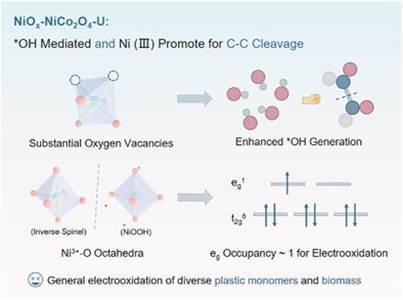
To address this challenge, Professor Zhang's team innovatively designed and constructed a composite electrocatalyst (NiOₓ–NiCo₂O₄-U) that is enriched with oxygen vacancies and features a unique low-crystallinity, inverse-spinel structure. During the hydrothermal synthesis of the electrocatalyst, the precise modulation of urea dosage successfully induced NiCo₂O₄ to adopt an inverse-spinel configuration, thereby generating a large number of Ni³⁺–O octahedral active units with eg orbital occupancy approaching 1. This distinctive electronic structure, combined with a high concentration of oxygen vacancies, endows the catalyst with dual synergistic C–C bond cleavage capabilities (involving the in situ generation of NiOOH active sites and the synergistic promotion of C–C bond cleavage via *OH attack). Experimental results demonstrated that in the electrocatalytic oxidation of lactic acid (the monomer of PLA) to acetic acid, the catalyst achieved a Faradaic efficiency as high as 99.2%, with excellent yield at industrial-scale current densities. More importantly, it could universally and efficiently convert at least 10 types of oxygenated small molecules—including ethylene glycol, glycerol, and glucose—into acetic acid or formic acid. Techno-economic analysis indicated that this process holds favorable profitability prospects.
This study opens up new avenues for designing universal, high-performance electrocatalysts for the valorization of waste plastics and biomass, and provides significant guidance for advancing the industrial application of the related technologies. The publication of this achievement reflects yet another major breakthrough made by our university in the interdisciplinary field of electrocatalysis and green chemistry, and further enhances the university's visibility and influence in the international chemistry community. (Reviewed by Yunfeng Chen)
