(Correspondent: Jing Zhu) Recently, the research team led by Professor Yawen Zhang from the School of Chemical and Environmental Engineering at Wuhan Institute of Technology published their latest research findings in the internationally renowned top journal in the field of chemistry, Journal of the American Chemical Society (JACS). The paper is titled "Efficient Electrolysis of Biomass-Derived Carbonyl Compounds to Alcohols via Lanthanide-Modulated Hydrogenation Pathways." Professor Junxia Yu from the School of Chemical and Environmental Engineering at Wuhan Institute of Technology and Guangxu Lan, a specially appointed research fellow from the College of Chemistry and Molecular Engineering at Peking University, serve as the co-corresponding authors, with Jin Zhou, a doctoral student from Peking University, as the first author. This work was supported by the National Key Research and Development Program of China, the National Natural Science Foundation of China, the Innovation Project of the Beijing National Molecular Science Research Center, and the Scientific Research Start-up Fund of Wuhan Institute of Technology.
The high-value conversion of biomass resources is one of the key pathways toward achieving a sustainable chemical industry. Levulinic acid, as an important biomass platform molecule, can be hydrogenated to γ-valerolactone—a green solvent and fuel precursor with a market value nearly seven times higher, holding broad market prospects. However, traditional thermal catalytic hydrogenation requires high temperature and high pressure, resulting in high energy consumption and significant environmental burdens. Although electrocatalytic hydrogenation can proceed under mild conditions using water as the hydrogen source, it has long been plagued by competition from the hydrogen evolution reaction (HER), leading to low selectivity and poor efficiency—a recognized bottleneck in this field.
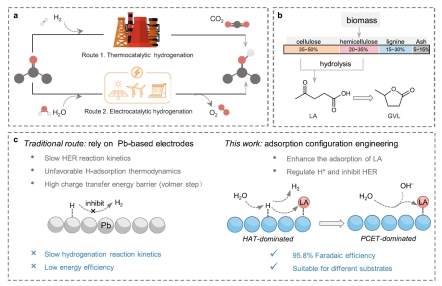
To address this challenge, Professor Zhang's team innovatively proposed an "adsorption configuration engineering" strategy. By introducing lanthanum oxide modification onto the surface of hexagonal close-packed cobalt nanoparticles, they constructed a La₂O₃/Co inverse catalyst. Through the synergistic interfacial interaction between lanthanum oxide and cobalt, this catalyst achieved precise regulation of the reaction pathway. The study revealed that the introduction of lanthanum oxide enhanced the preferential adsorption of the substrate (levulinic acid) molecules on the catalyst surface while suppressing the activation of interfacial water, thereby blocking the conventional reaction pathway that relies on surface-adsorbed hydrogen atoms and redirecting the reaction toward a proton-coupled electron transfer (PCET) pathway. Under this mechanism, the electrocatalytic hydrogenation of levulinic acid to γ-valerolactone achieved a Faradaic efficiency as high as 95.8%, with excellent yield. Techno-economic analysis demonstrated that the production cost of this electrosynthetic route is far below the current market price, indicating favorable profitability. Furthermore, this strategy exhibited good universality for the electrochemical hydrogenation of a series of water-soluble biomass-derived carbonyl compounds to their corresponding alcohols.
This study not only provides a brand-new catalyst design concept for the efficient electrohydrogenation of biomass-derived carbonyl compounds but also opens up a new direction for utilizing rare-earth elements to modulate electrocatalytic reaction pathways. The publication of this achievement reflects yet another major breakthrough made by our university in the interdisciplinary field of electrocatalysis and green chemistry, and holds positive significance for enhancing the university's academic influence in this field. (Reviewed by Yunfeng Chen)
