(Correspondent: Cheng Jing) Recently, the final review meeting for the Hubei provincial teaching research project "Integration of the 'Dual Carbon' Strategy into Environmental Engineering Talent Training Program Based on the OBE Concept," led by Professor Zhou Xuan of our college, was successfully convened. The review invited Professor Liu Qiongyu (Associate Dean) from Jianghan University, Professor Zhang Huiling from Wuhan University of Science and Technology, Professor Li Zhu (Associate Dean) from Hubei University of Technology, Professor Tong Lei from China University of Geosciences (Wuhan), and Professor Chen Wei from Wuhan Institute of Technology to form an expert panel, with Professor Liu Qiongyu serving as the review team leader. The meeting was chaired by Professor Li Junbo, Associate Dean of Teaching in our college. Professor Zhou Xuan, the project leader, along with key project team members including Professor Wang Yingru, Associate Professor Guo Li, and Associate Professor Cheng Jing, attended and presented at the meeting. Following a comprehensive evaluation by the expert panel, the provincial teaching research project successfully passed the final acceptance review.
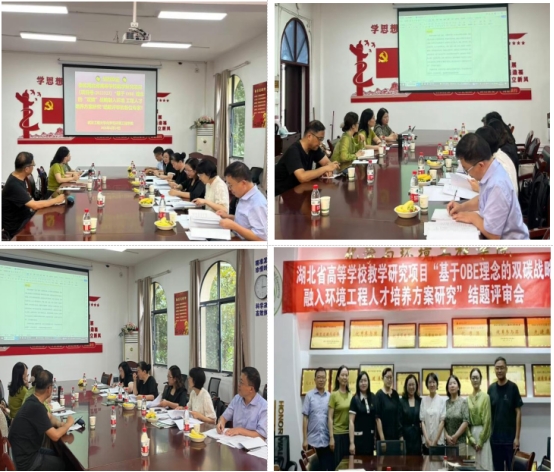
The project was officially approved in January 2024. During the research period, the team closely aligned with the national "Dual Carbon" strategy and the needs of engineering education reform. Guided by the OBE concept and integrating curriculum-based ideological and political education, the project focused on the current challenges in cultivating low-carbon talent in environmental engineering. Research was carried out across multiple dimensions, including top-level talent training design, curriculum development, teaching resources, practical training, faculty development, and outcome dissemination, exploring an OBE-based practical education model that integrates the "Dual Carbon" goals into environmental engineering programs.
During the presentation, Professor Zhou Xuan provided a comprehensive overview of the project's research background, objectives, methods and processes, main outcomes, and innovative aspects. The expert panel meticulously reviewed the final materials, engaging in in-depth discussions and inquiries with the project team on key issues such as the scientific rigor of the research and the innovation and practical value of the outcomes. After intensive deliberation, the expert panel unanimously concluded that the project had completed all research tasks on schedule, with complete and standardized documentation meeting the requirements for provincial teaching research project finalization, and thus approved the project’s conclusion. The panel also recommended that the team further refine the outcomes and strengthen the promotion and application of the findings, so as to provide valuable references for other universities in aligning environmental engineering programs with the "Dual Carbon" strategy.
The successful finalization of this provincial teaching research project not only demonstrates the solid teaching research capabilities of our faculty but also marks the successful completion of the project’s research phase, laying a strong foundation for further consolidation and practical application of the outcomes. Moving forward, our college will continue to leverage teaching research projects as a key driver, promote the dissemination and application of research findings, encourage faculty to deepen classroom innovation, and persistently enhance the quality of professional development and talent cultivation. (Reviewed by Li Junbo)
