(Correspondent: Yang Zi) To broaden the academic horizons of our faculty and students, keep pace with the latest developments in sensing technology, assist them in mastering submission methods for high-level journals, and enhance their research innovation capabilities, on the afternoon of May 12, 2026, Professor Zhang Yawen of our college specially invited Professor Lin Xinyi from Nanyang Technological University, Singapore, and Dr. Zhang Ge, Managing Editor for China at ACS Publications, to deliver special academic lectures at our college. The lectures were held in Room 202 of Zhonghe Building, chaired by Associate Dean Chen Yunfeng, and attended by Dean Yu Junxia, Associate Dean Zhao Qingbiao, along with faculty and student representatives.
Professor Lin Xinyi delivered a talk titled "Combining Surface-Enhanced Raman Scattering and Machine Learning for Chemical and Biomedical Sensing," sharing the latest research achievements at the intersection of sensing and artificial intelligence. She pointed out that Surface-Enhanced Raman Scattering (SERS) technology offers significant advantages in ultra-sensitive and rapid detection, with broad application prospects. However, it currently faces technical bottlenecks such as weak affinity and insufficient specificity, which limit its large-scale application. To address these challenges, Professor Lin's team innovatively optimized the detection system by modifying molecular receptors on the SERS interface to construct a hyperspectral system, and introduced machine learning algorithms to build intelligent prediction models, effectively avoiding human errors and greatly improving detection accuracy and analytical capabilities. Based on this cross-disciplinary technology, the team successfully developed a SERS-based COVID-19 analyzer capable of accurately identifying positive cases and asymptomatic carriers, providing an efficient and reliable technical solution for rapid epidemic screening, fully demonstrating the innovative value of interdisciplinary integration.
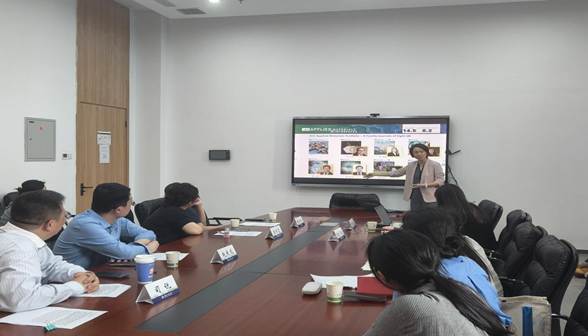
As the Editor-in-Chief of ACS Applied Materials & Interfaces, Professor Lin Xinyi also introduced the journal's development positioning and disciplinary strengths. She noted that the journal holds significant influence in fields such as materials, chemistry, and the environment. By 2023, its publications accounted for 25% of the total ACS journal output, making it a core high-quality journal in the field. She encouraged faculty and students to delve deeply into cutting-edge research, refine their innovative achievements, and actively submit to high-level journals.
Subsequently, Dr. Zhang Ge delivered a special presentation on the ACS journal submission process and the use of academic resources. He systematically introduced the classification system, publication characteristics, and submission overview of ACS journals, with a special focus on high-quality public resources available on the platform, including paper writing guidance, format standardization training, and peer review learning materials. He advised faculty and students to make good use of the official platform to enhance their scientific writing skills and actively showcase their academic achievements.
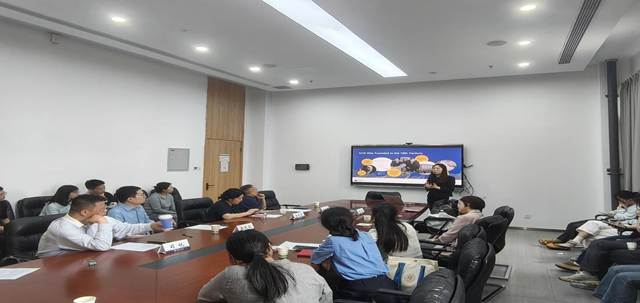
The entire lecture was concise, cutting-edge, and highly practical. Professor Lin Xinyi's sharing on interdisciplinary research broadened the research perspectives of faculty and students, showcasing innovative directions in the field of intelligent sensing. Dr. Zhang Ge's journal guidance effectively addressed practical concerns regarding submission and writing. The lecture site was filled with a strong learning atmosphere, and the audience responded enthusiastically, with many expressing that they had greatly benefited from the session.
This lecture provided a valuable platform for our faculty and students to connect with cutting-edge research and authoritative journals, enabling them to gain in-depth understanding of research progress in the interdisciplinary field of intelligent sensing and machine learning, as well as systematically master the submission essentials and resource utilization methods for ACS journals. The event effectively stimulated the research innovation enthusiasm of faculty and students, and played a positive role in regulating academic research, enhancing the output of high-level achievements, and promoting the development of interdisciplinary disciplines and the cultivation of innovative talents in our college. (Reviewed by Chen Yunfeng)
